




August 2024
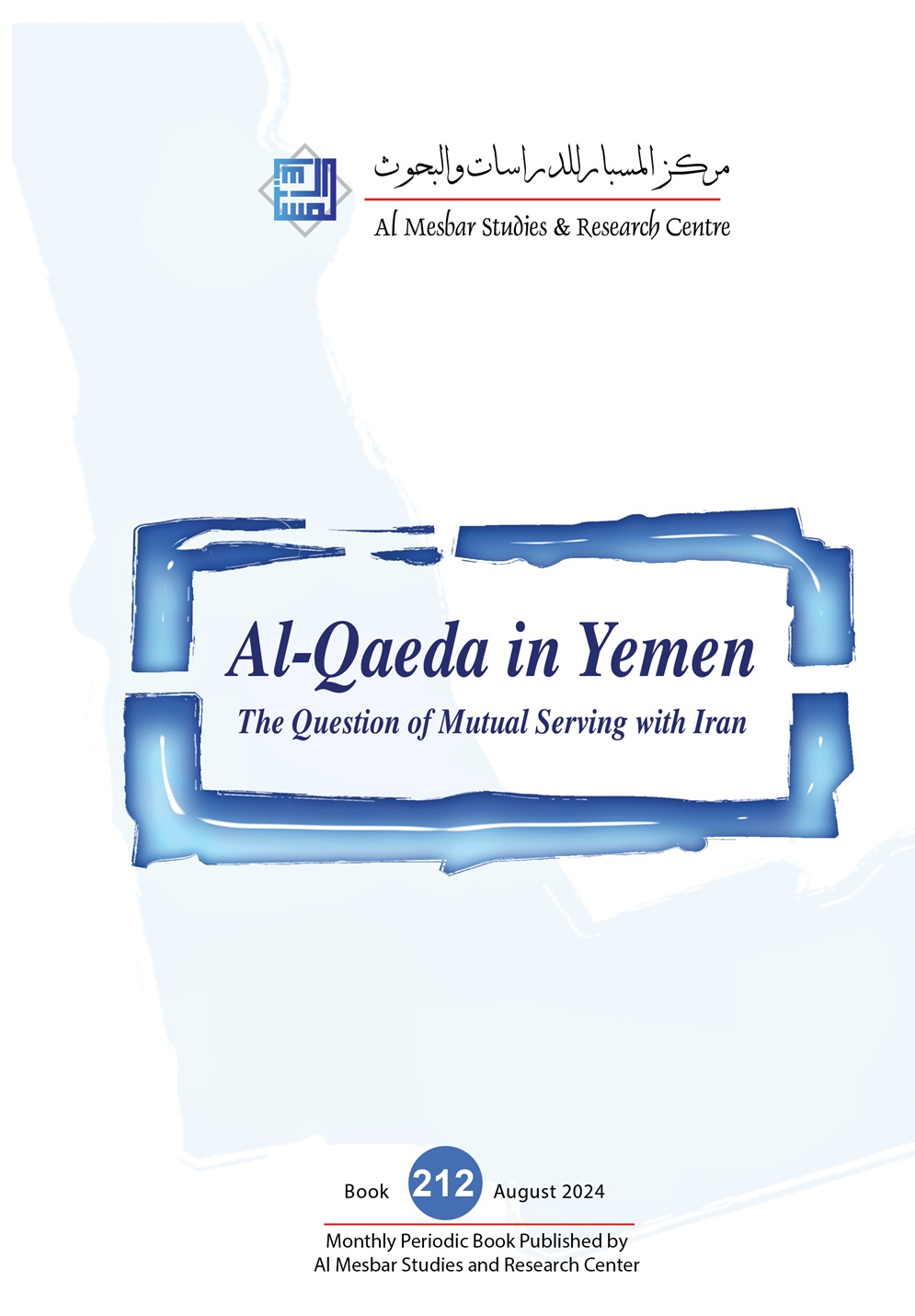 In its 212th book, “Al-Qaeda in Yemen: The Question of Mutual Serving with Iran,” published August 2024, the Al-Mesbar Studies and Research Center examines the transformations of Al-Qaeda in Yemen over the past decade. It analyzes Al-Qaeda’s relationship with Iran and the Houthis, focusing on their logistical, ideological, and security coordination, especially following the October 7th attacks, which Al-Qaeda equates with the “blessed raid” of September 11th.
In the book’s opening study, Tariq Al-Omari traces the development stages of Al-Qaeda in Yemen. He documents how northern Yemeni states instrumentalize religion politically, including former President Ali Abdullah Saleh’s use of religious ideology to combat leftist trends. Al-Omari explores Al-Qaeda’s establishment before the 2009 merger of its branches up to the present. He catalogues terrorist attacks such as the Omar Abdul Mutalib’s attack in 2009 and the 2015 Charlie Hebdo attack, highlighting leadership changes and adaptations to internal and external challenges.
The study outlines Al-Qaeda’s recruitment strategies, operational expansion within and beyond Yemen, and the development of ideological theories that justify violence and attract recruits.
Abdul Razzaq Ahmed Ali analyzes internal factors driving structural and ideological changes within Al-Qaeda. The organization exploits intellectual vacuums during President Saleh’s era and applies the “Sunni project” theory, especially after the Houthi group’s takeover of northern Yemen and the sectarian reshaping of society.
The rise of ISIS challenged Al-Qaeda, causing internal fragmentation. The Yemeni branch initially hesitated to label ISIS as blasphemous or “Kharijites,” the preferred term for ostracized groups in the jihadist lexicon, instead considering them “our brothers.” Under Khaled Batarfi’s leadership, Al-Qaeda confronted ISIS after it declared itself a caliphate. Although Al-Qaeda once controlled entire cities, its influence declined sharply after Operation Decisive Storm brought a strong Gulf-led counter-terrorism effort to Yemen. AQ’s presence shrunk further by 2022, following Shabwa’s liberation. Nevertheless, it resurged suddenly in 2023 with new funding, tactics, and propaganda that require further analysis.
Mohamed Ahmad al-Basha proposes several scenarios for Al-Qaeda’s future in Yemen (2014–2024), based on tribal dynamics, government confrontations, international involvement, ideological competition, and adaptation strategies. All scenarios involve preparations for new confrontations, shifting alliances, and reliance on rogue states. The public phase began with Al-Qaeda announcing a new name, following Islamist groups’ tradition of strategic deception by rebranding for tactical considerations.
Mahmoud Al-Atmi and Ashraf Al-Mansh explore Al-Qaeda’s relationship with Iran, tracing connections from the organization’s inception. Al-Qaeda initially aligned with Sudan’s National Islamic Front regime, whose Islamic Popular Conference Party included Al-Qaeda elements, Hezbollah symbols, and Revolutionary Guard leaders, forming a brotherhood-based relationship. Following Al-Qaeda’s defeat in Afghanistan after the U.S. campaign against the Taliban (2001–2021), members and families found refuge in Iran. The study discusses a security agreement between AQ leader Saif Al-Adel and Iran’s Qassim Soleimani, periods of inactivity, and Saif Al-Adel’s re-emergence after AQ Emir Ayman al-Zawahiri’s death, highlighting mutual needs for cooperation. The researchers conclude that a mid-2023 agreement revitalized the organization, evident in its ties with the Houthis. They note that Saif Al-Adel’s son played a role in forging this rapprochement, which Khaled Batarfi acknowledges. After their deaths, Al-Qa’eda leader Saad al-Awlaki followed the same path. The Houthis reportedly released some Al-Qaeda members in exchange for monetary ransom. The study also examines the impact on Somalia, identifying Houthi and Iranian influence in Al-Shabaab’s weapons and drones, sharing the same weapons corridors.
Egyptian researcher Mustafa Zahran explores the relationship between Iran and Al-Qaeda, highlighting evidence that drones acquired by Al-Qae’da originated with Houthi elements. He suggests technical cooperation and possible transfer of surveillance, espionage, and information operations link Somalia’s Al-Shabaab to the Houthis. Ideologically, he notes the emergence of a trend promoting unity of purpose between Al-Qaeda and this new alliance, both of which glorify the “October 7 Operation” against Israel to build legitimacy, and put on even footing with Al-Qaeda’s September 11, 2001 “operation.”
Amjad Khushafa examines ideological differences between Al-Qaeda and ISIS’s respective branches in Yemen. He recounts the transformations in the approaches of the two main organizations in Afghanistan and Iraq and how these have influenced Al-Qaeda. He analyzes their ideological and military strategy differences and their effects on Al-Qaeda’s potential decline or growth.
Terrorism has plagued Yemen, with significant economic ramifications studied by researcher Mohamed Al-Sharabi. He identifies the multifaceted economic consequences of Al-Qaeda’s activities, noting how terrorism hinders economic growth, disrupts major industries, and worsens the humanitarian crisis. He suggests possible recovery and stability paths for Yemen’s post-conflict phase.
Researcher Ihab Al-Sharif investigates Al-Qaeda’s internal and external funding sources in Yemen, detailing their origins, methods, associated risks, and the organization’s efforts at diversifying its revenue streams.
Al-Qaeda in the Arabian Peninsula (AQAP) bases its influence on ideological propaganda disseminated through its media publications, which uphold consistent narratives on the Yemeni conflict. Mohamed Kamal Mohamed critically analyzes coverage of Yemen’s events by two major Al-Qaeda-affiliated publications: the English-language magazine Inspire and the newspaper Al-Masra. He analyzes their narratives from 2019 to 2024, examining their coverage of Yemen’s ongoing conflict, governance issues, and power dynamics. His analysis shows how these media outlets serve as tools for strategic communication, recruitment, and ideological reinforcement.
Awad Mohamed and Maher Farghali study AQAP’s media and its future role, defining the media’s influence on terrorism growth in Yemen, identifying affiliated media institutions, and outlining media process changes after the “October 7, 2023 Operation.”
Yemeni expert and activist Khaldoun Bakheil develops a national discourse for reconciliation by diagnosing extremism. He emphasizes that Yemen’s political, security, and social fragmentation provides Al-Qaeda with opportunities to renew and deepen ties with local communities in Abyan, Shabwa, Al-Bayda, Marib, and other southern governorates.
In conclusion, the Al-Mesbar Studies and Research Center thanks the contributing researchers and those involved in publishing this book. We hope it fills a gap in the Arab scholarly library.
Editor-in-Chief
Omar Al-Bashir Al-Turabi
August 2024