




November 2024
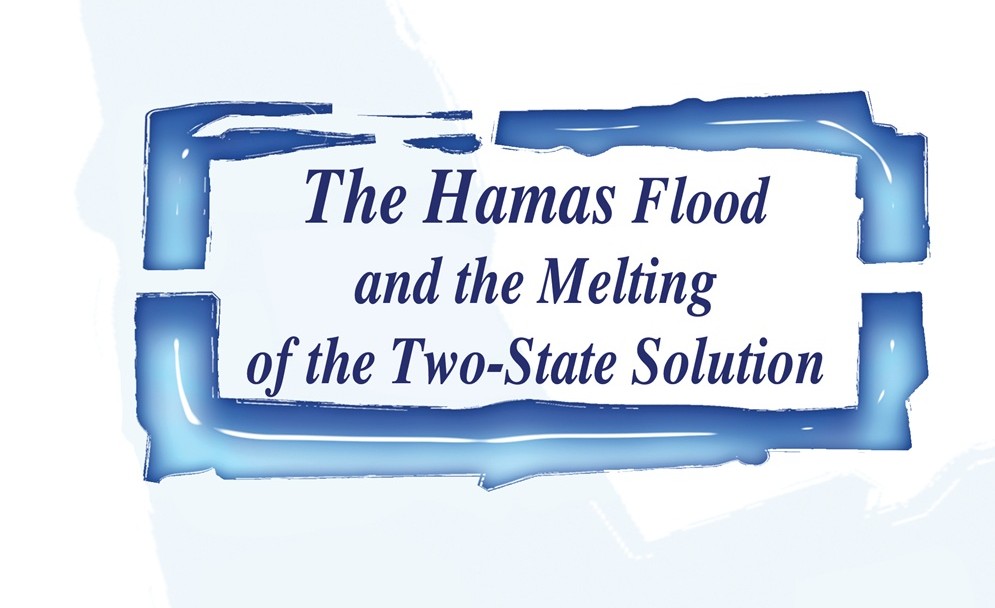
 In its 215th book, “The Hamas Flood and the Melting of the Two-State Solution,” published November 2024, the Al-Mesbar Studies and Research Center analyzes the effects that Hamas’s attacks on October 7, 2023 have had upon the regional peace process. The book completes its study of the periods during which Hamas evolved, from the 2007 coup to its rapid launch of the 2023 operation, which led to severe humanitarian and political consequences. This in turn has led to the breakdown of efforts toward the two-state solution and strengthened the groups opposing it.
Hamas’s rejection of the two-state solution is not new, but its role in recent events has shifted. The book tracks key moments when Hamas asserted itself as the sole option for Palestinian governance, rejecting any other framework of Palestinian statehood.
Iraqi counter-terrorism researcher Omar Dhibyan examines both the consistent and changing elements in Hamas’s discourse from its founding generation, which remains largely in place even after Yahya al-Sinwar’s death: Khaled Meshaal and Khalil Al-Hayya. He suggests that internal changes between 2010 and 2023 reflect internal conflicts among differing factions, culminating in the dominance of what he terms the “hardline military leadership.” Sinwar played a central role after his 2011 release in the Gilad Shalit deal, becoming the de facto leader of the military wing and developing its armed strategy. This leadership peaked with the October 7, 2023 attack, which Iran used to advance its regional agenda, which stands in stark opposition to comprehensive peace.
Dhiban observes that Iranian support and Hezbollah training enhanced Hamas’s land, air, and sea capabilities and tactics. He also notes Hamas’s use of the same media apparatus to redirect international support for Palestine toward Hamas itself.
Continuing the study of Hamas’s organizational structure before and after the October 7 operation, Lara Al-Hindawi explores the structural, political, and ideological foundations shaping the movement’s internal and external relations. The study weighs these factors and assesses their impact on Hamas’s decision-making and structural transformations surrounding the October 7th attacks.
Mohamed Ali Al-Husseini addresses Hamas’s future after the operation, which he describes as a self-destructive attack affecting both internal and external factors. Internally, it intensified divisions between the political and military wings, especially between Ismail Haniyeh and Yahya Al-Sinwar. He notes that Sinwar’s death sparked conflicts between the Khalil Al-Hayya faction, loyal to Iran, and the Khaled Meshaal faction, aiming for absolute control. Al-Husseini contends that Hamas has brought great harm to the Palestinian cause by failing to preserve the two-state project and undermining its legitimacy.
Raed Najm reclassifies Hamas’s political strategy since its 1987 founding, focusing on the 2007 coup and its takeover of the Gaza Strip. He observes that Hamas has oscillated between ruling Gaza and its people, appeasing Israel, and engaging in armed resistance, facing intertwined internal and external challenges in doing so.
The study reviews the various stages of Hamas’s political development: ideological formation (1987–2006); political participation and military coup (2006–2007); consolidating Gaza rule and using resistance to legitimize itself (2007-present). Najm notes the movement uses armed resistance to justify political authoritarianism, suppressing internal opposition and tightening security control, especially after repeated confrontations with Israel, from the 2008 war to the 2023 escalation.
The study concludes by highlighting the deep contradictions in Hamas’s behavior and rhetoric, which place it in constant conflict with other Palestinian factions and exacerbate internal divisions rather than creating a unified national front.
Hamas’s funding sources and financial assets attract scholarly attention, amid ongoing discussions of its economic empire. Sameh Abbas surveys studies addressing Hamas’s funding, assets, financial institutions, and companies inside and outside Gaza, its economic situation, and ties to regional actors aligned with Iran’s agenda.
Egyptian researcher Hesham El-Naggar analyzes Iran’s motives for launching the October 7th attacks, arguing it sought to block major regional peace agreements. Iran bolstered Hamas in its determination to halt progress towards a two-state solution. Hamas, in turn, sought to position itself as Palestine’s leader, and despite heavy humanitarian and battlefield losses, it has in some respects advanced its ideological goals. It provided the Muslim Brotherhood a propaganda revival opportunity, undermining not only support for the two-state but even the concept of state authority, attacking moderate regional states and promoting theories heralding the demise of the “post-colonial state.”
Egyptian researcher Tarek Abu Al-Saad examines how the international Muslim Brotherhood has exploited October 7th, analyzing Brotherhood factions’ statements that mobilize extremist sentiment and kindle resentment against moderate states.
To assess Hamas’s recruitment efforts, Ahmed Al-Ayyoubi studies the revival of recruitment in Palestinian camps in Lebanon on the part of the Muslim Brotherhood. He outlines the history of twelve camps, focusing on Ain al-Hilweh and Nahr al-Bared, which experienced chronic violence and armed clashes. He explains that Fatah al-Islam, led by Shaker al-Absi, typifies the exploitation of camp environments for recruiting refugees to form armed groups within Nahr al-Bared. Al-Ayyoubi highlights Ain al-Hilweh as a jihadist stronghold hosting groups like Osbat al-Ansar and Jund al-Sham, which follow al-Qaeda’s ideology advocating overthrowing regimes and imposing “Allah’s rule” by force. He details links between these groups and al-Qaeda, citing figures like Hisham Sharadi and Ahmed Abdel Karim al-Saadi Abu Mihjan, leaders of extremist activities within the camps.
Al-Ayyoubi notes that Hamas exploited the camp environment after the October 7, 2023 operation by announcing the formation of the “Al-Aqsa Flood Vanguards,” calling on youth to “resist the occupation.” However, Lebanese forces, including Prime Minister Najib Mikati and Sami Jemayyel, widely rejected this, viewing it as violating Lebanese sovereignty and stirring up memories of the prelude to Lebanon’s civil war.
The study also discusses the recruitment of displaced Syrians, noting how some extremist groups have sought to exploit them. One striking example occurred in the outskirts of Ersal in 2014 when ISIS and Jabhat al-Nusra took control of wide swaths of the town. However, Al-Ayyoubi contends that most displaced Syrians remained neutral and did not engage in militant activity.
Hussein Abdul Hussein of Washington’s Foundation for Defense of Democracies examines how Arab and Muslim communities in the United States responded to the October 7 attacks and the Hamas-Israel conflict. He highlights the communities’ limited influence on U.S. internal politics and decision-makers and their impact on the Palestinian cause and two-state solution’s future.
Emily Blout’s study, “October 7 Operation from a Media Perspective,” begins with an overview of the main belligerents and the political context, followed by a description of the attack. While each campaign element has operational value, the study argues it also serves critical propaganda purposes.
In conclusion, Al-Mesbar Studies and Research Center thanks the contributing researchers and those who worked to publish the book. We hope it fills a gap in the Arab scholarly library.
Editor-in-Chief
Omar Al-Bashir Al-Turabi
November 2024