




December 2024
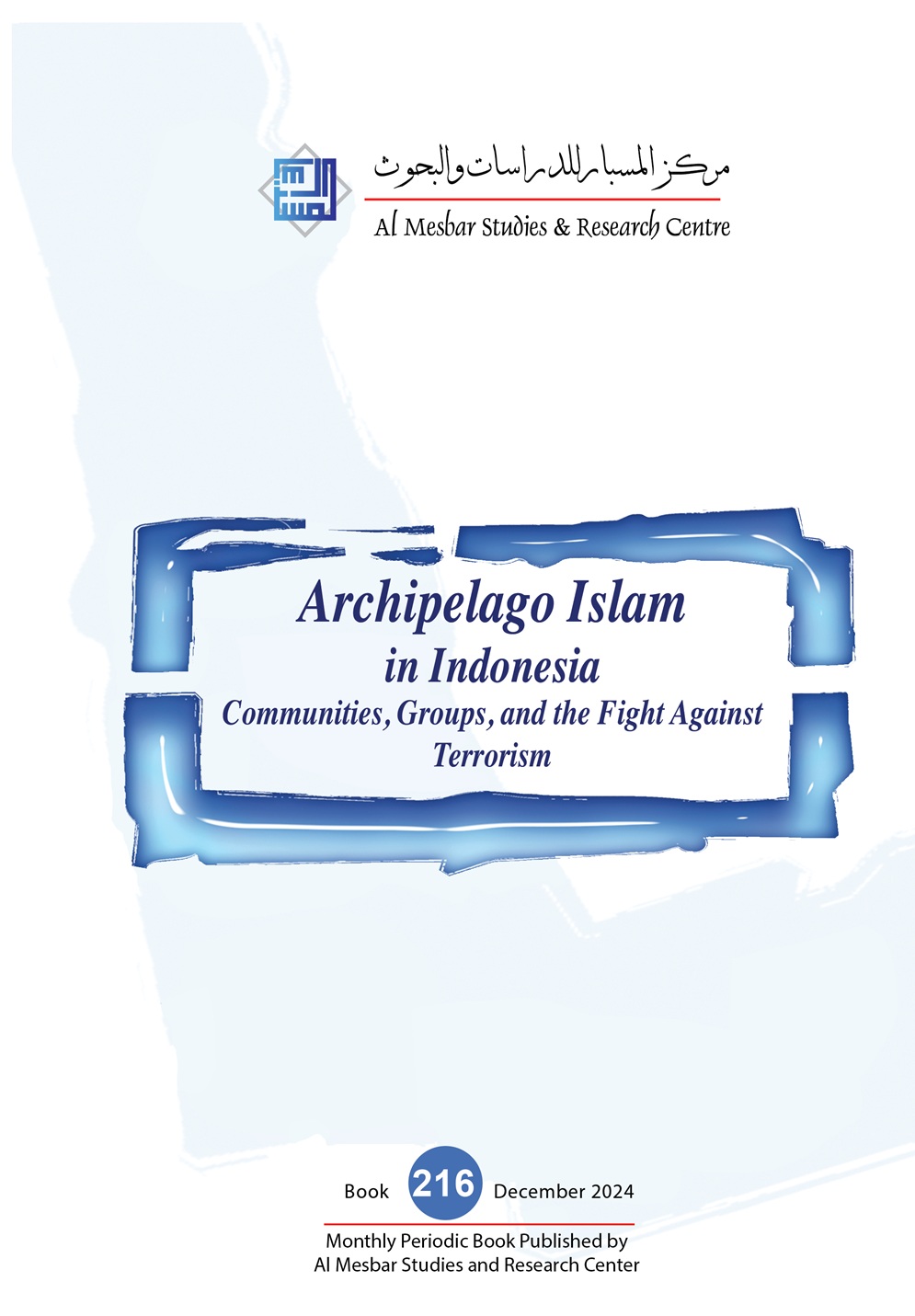 In its 216th book, “Archipelago Islam in Indonesia: Communities, Groups, and the Fight Against Terrorism,” published December 2024, the Al-Mesbar Studies and Research Center explores the history of Indonesian Islam and how it peacefully adapts to local traditions, customs, and cultural practices over time. It examines this cultural-religious adaptation within local and expatriate Muslim communities, their popular religious practices, and their religious education. The book documents the rise of traditional Islamic institutions and the founding of key associations, especially Muhammadiyah (1912) and Nahdlatul Ulama (1926), which are among the most influential groups in the country.
The relationship between religion and political power in the democratic era amid ongoing political reforms are a central focus. The study addresses the challenges posed by Islamist terrorism, its early development, and the threats it poses to the state, society, and religion, as well as the Indonesian government’s efforts to combat terrorism and rehabilitate extremists.
The book offers new studies that aim first to examine the link between Indonesian Islam’s past and present. Second, it explores changes the religion undergoes across different periods, especially in the early 21st century. These include the Islamist influences from the Middle East, contrasted with government measures that evolved from cautious beginnings to more consistent and decisive actions against terrorism.
Hijrian Angga Prihantoro, a professor at the State Islamic University of Sunan Kalijaga (UIS), studies Indonesian Islam from the 7th century through modern times. He surveys the major Muslim associations, particularly Muhammadiyah and Nahdlatul Ulama (NU), the two largest social organizations in Indonesia. He describes the founding impetus of these groups behind and analyzes their religious discourse and projects. Muhammadiyah has promoted renewal since 1912, from ijtihad to what it calls “Progressive Islam,” a project presented at its 47th National Congress in 2015 in Makassar.
Nahdlatul Ulama (NU) introduced the concept of “Islam Nusantara,” or “Islam of the Archipelago,” at its 33rd National Congress in Jombang in 2015. This vision promotes a comprehensive and peaceful Islam in Indonesia and globally. The organization offers a jurisprudential adaptation centered on loyalty to the state and values ostensibly secular achievements as acts of worship at the heart of religious behavior. It emphasizes the “triad of brotherhood” of religion, nation, and humanity, using scholarly approaches that encourage peace among Indonesians and within the broader human civilization.
The association believes it provides a counter-narrative to extremist Islamist ideologies. Its project embodies a distinctive Indonesian Islam characterized by cultural diversity, moderation, tolerance, coexistence, and harmony with local traditions. It stresses preserving valuable traditions while adopting suitable new ones. It embraces social concepts that foster brotherhood, cultural adaptation, respect for moderation and tolerance, and pride in local sources of wisdom and social harmony.
The two associations take different approaches to the relationship between religion and the state. Muhammadiyah develops the concept of the House of Covenant and Wisdom, considering the Pancasila State and its principles as such a house. By contrast, Nahdlatul Ulama regards Indonesia as the House of Islam and accepts Pancasila as the state’s foundation.
Prominent figures include Abdurrahman Wahid (1940-2009), grandson of NU’s founder and later president, known as Gus Dur, who introduced the term “Pribumisasi Islam” (Localization of Islam) in the 1980s. Members of both groups serve in government and educational roles and contribute to social movements. Muhammadiyah established the Muhammadiyah Youth Organization and leadership programs (KOKAM), similar to NU’s Ansar Youth Movement and multi-purpose Ansar Front program (Banser). Both groups also launched women’s organizations: the Aishiyya Association for Muhammadiyah and the Muslim Women Association for NU.
Fahim Khasani discusses two main issues within Indonesian Islam: first, its dialectic between normative Islam and local culture based on peaceful adaptation; second, unique Islamic traditions specific to Indonesia that remain preserved. The Indonesian experience begins with the symbolism and roles of the nine saints (Wali Sanga), who adapt Islam to local culture and identity, expressing it through popular religiosity, traditions, and social customs. They use local language and concepts from Buddhism, Hinduism, and Kapitan to explain Islamic ideas, facilitating acceptance without compromising faith. Examples include terms like “kanjin nabi” for Prophet, “kiyahi” for cleric, and “guru” for teacher. Arabic terms like patience (Sabr), justice (‘Adl), and satisfaction (Rida’) are also integrated.
The religion incorporates traditions and rituals compatible with Dhikr, Mawlids, and Hadras. Early teachers adopt certain traditions that share similarities with Islam. Khasani presents anthropological models referencing traditions like salamitan, a feast for blessings. He relies on “cultural assimilation” theory, showing how Indonesian Islam underwent long-term acculturation with local elements, similar to Hinduism, Buddhism, and Christianity, resulting in distinct local practices.
On the history of Islamic education, researcher Tedi Kholiludin, a lecturer at Universitas Wahid Hasyim, surveys the social roles of religious leaders and teachers in rural Indonesia. His field research covers villages Manis and Paheng (Gibug or Bojong Gibug). He examines religious education history and institutions in these models. Three main types of worship places exist in popular Islam: mosque (masjid), langgar, and tajug, each with distinct religious and social functions.
The cultural boom of the 1990s wrought many changes in Indonesian religiosity, with some holding religious sessions at home outside traditional associations like NU. New groups like Jama’at Millathu Ibrahim and Jama’at Tarbiyah sought to wrest control of mosques from traditional leaders. Kholiludin notes langgar’s homogeneity, smaller than mosques, held periodic rituals that prevented Muslims from joining new trends, highlighting the “traditional Muslim” concept prevalent in Central and East Java, known for its tolerant population. He explores relationships between religious schools and local government, linked via village leaders’ contracts with religious teachers or “Kayahi,” whose religious culture derives from the village. He examines distinctions between Kayahi Sufi orders, Kayahi Institute, and Kayahi Quran.
Rahmat Aming Lasim studies Indonesian social and cultural religiosity influenced by moderating trends originating from Al-Azhar. He first examines Al-Azhar in Egypt as a religious institution contributing to social and cultural changes in Indonesian Islam from 2011 to 2024. Lasim traces historical ties between Al-Azhar and Indonesian Islam, highlighting their shared moderate Islamic vision and advocacy, expressed through historical interaction, scholarly links, and identity similarities.
In the area of religion and politics, constitutional law lecturer Gugun El Guyanie analyzes the dynamics after the 1998 fall of the “New Order” regime. The reforms allow greater freedom of expression and organization. Decentralization enables special local laws, as in West Sumatra and Aceh Province, where Sharia law is implemented. Since 2004, Indonesian actors have sought to reform Islamist ideology globally by promoting a moderate Muslim voice, compatibility of religion with local culture and state authorities, and advancing multiple interpretations accepting modern concepts of citizenship.
Regarding Islamist terrorist organizations, researchers Muhammad Sofyan and Muhammad Syauqillah chronicle their history and development. They compare two historical factors: the Padri War (1803-1837), which seeded religious extremism reflecting conflict between imported extremism and traditional Shafi’i Islam; and the 1924 abolition of the Caliphate, leading to Islamist movements like Darul Islam (DI), founded in the late 1940s by Sekarmadji Maridjan Kartosoewirjo (1907-1962), and influenced by leftist and nationalist ideas which lent his project a revolutionary religious dimension. DI attracted former military personnel and operated in West Java, Aceh, South Sulawesi, and Kalimantan but ended officially after Kartosoewirjo’s execution in 1962.
New groups have since emerged, including Jemaah Islamiyah, founded in Malaysia in 1993 and linked to al-Qaeda; the Indonesian Mujahideen Council, focused on the forcible implementation of Sharia; and the Tawhid and Jihad Group, led by Aman Abdurrahman, which marked a transition toward allegiance to ISIS. Later groups like Jama’at Ansar Al-Tawhid and Jama’at Ansar Al-Dawlah arose from splits and adopted armed action and extremist online propaganda. Extremism in Indonesia originates not in traditional religious schools but among young men with a non-traditional education, influenced by external trends, discontent with local governments. These trends tended toward a clandestine approach, concealing their activities, facilitating the formation of sleeper cells, isolated groups, or lone wolves.
The book devotes three studies to counterterrorism in Indonesia. The first, by Nur Faizin, examines Nahdlatul Ulama’s role in combating extremism, reshaping Islamic traditions, and confronting terrorist groups.
The second, by terrorism researcher Hasibullah Sitrawi, focuses on the June 30, 2024 dissolution of Jemaah Islamiyah (JI), arguably Indonesia’s most influential and dangerous terrorist group. He analyzes the impact on counterterrorism strategies and compares it to reforms by JI in Egypt, interrogating claims that Indonesia’s changes were inspired by the Egyptian example, but finding little direct evidence to substantiate this theory.
The third, by Egyptian researcher Ibrahim Nigm, Secretary-General for the Fatwa Houses in the World, studies rehabilitation and dialogue programs in Indonesian prisons from 2005 to 2024. He analyzes Indonesia’s methods, achievements, challenges, and recommends applying this model elsewhere.
Indonesian researcher Muhammad Saifuddin examines prominent trends in Indonesian books via Detik magazine’s website (detik.com), reviewing November 2023 publications to identify views on religion, state, and heritage.
In conclusion, Al Mesbar Studies and Research Center thanks the contributing researchers and publication team, especially coordinator Mustafa Zahran. The center hopes this book fills a gap in the Arab library.
Editor-in-Chief
Omar Al-Bashir Al-Turabi
December 2024